

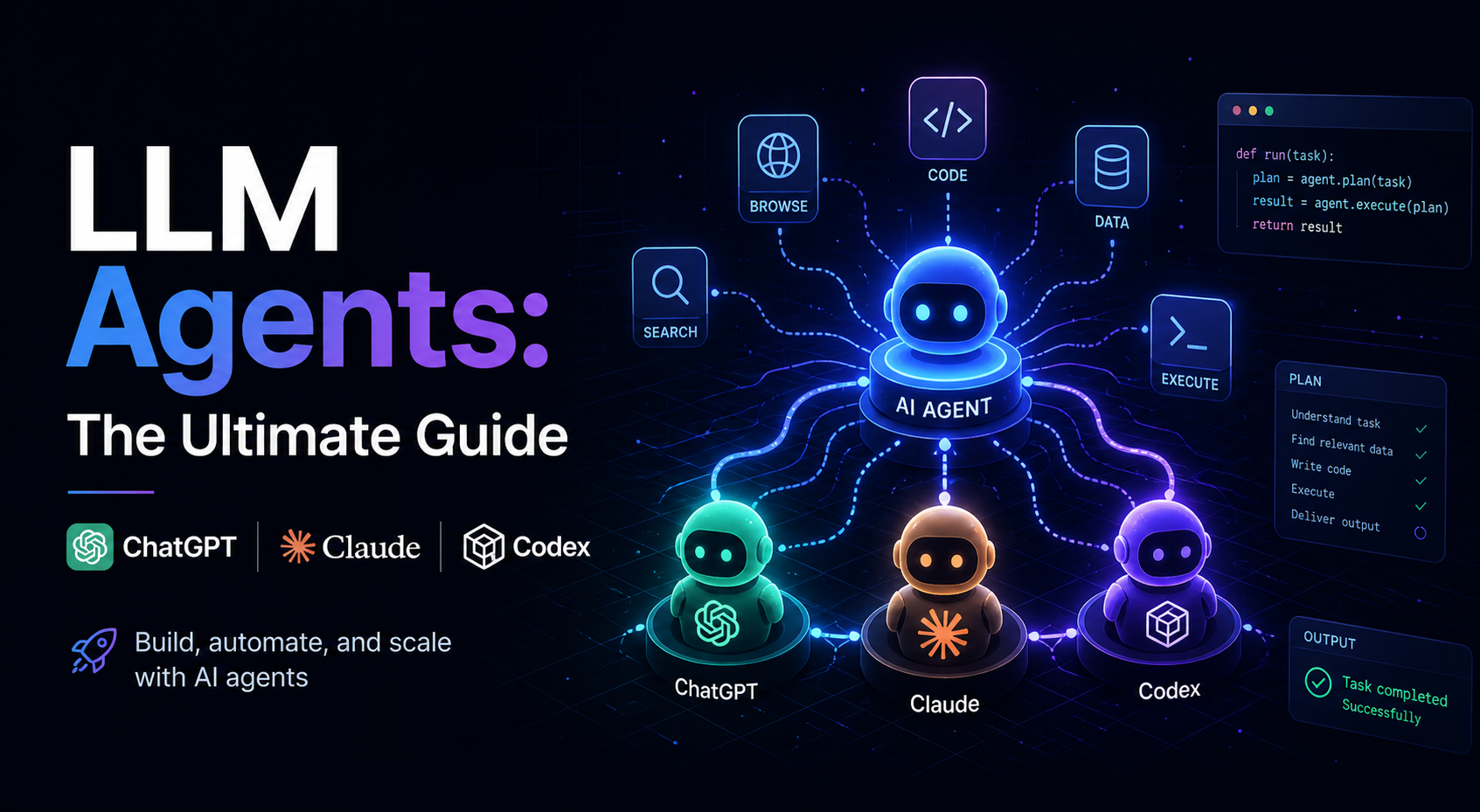

Choosing the right LLM agent has become a critical decision for developers and businesses in 2026. As autonomous AI systems move from experimental toys to production-grade employees, the “big three” contenders—OpenAI’s ChatGPT (powered by GPT-5.5), Anthropic’s Claude 4 series, and the specialised OpenAI Codex—offer distinct philosophies for handling complex tasks.
In the current landscape, more than 86% of organisations have moved beyond experimentation, deploying AI coding agents directly into production workflows (jsDelivr, 2026). However, selecting the wrong tool can lead to inefficient token usage or “hallucinated” logic. This guide breaks down the strengths of each platform to help you optimise your AI strategy.
The Evolution of LLM Agents in 2026
The definition of an LLM agent has shifted. It is no longer just a chatbot that answers questions; it is a system capable of planning, using tools, and executing multi-step workflows. Whether you are building an autonomous research assistant or a self-healing CI/CD pipeline, the underlying model determines the agent’s reliability.
While earlier iterations focused on simple text generation, today’s models are judged on their “agentic” capabilities—specifically how well they can operate within a terminal, manage a codebase, or browse the web to solve open-ended problems.
1. ChatGPT: The Versatile All-rounder
In 2026, ChatGPT (specifically the GPT-5.5 and GPT-5.2 series) remains the “Swiss Army knife” of LLM agents. It excels in environments where you need an agent to be a generalist—handling everything from image generation via DALL-E to native web browsing and computer use (Zapier, 2026).
Key Strengths:
- Ecosystem Breadth: ChatGPT offers the most integrated experience, combining voice, vision, and text-to-action capabilities in a single interface (Morph, 2026).
- Handling Vague Prompts: OpenAI’s models are famously forgiving. If your instructions are underspecified, ChatGPT makes reasonable assumptions to keep the workflow moving.
- Computer Use: GPT-5 leads in “computer use” benchmarks, allowing agents to interact with desktop applications and operating systems with 75% accuracy on OSWorld tests (Morph, 2026).
Best For: Users who need a “jack-of-all-trades” agent that can pivot between creative tasks, data analysis, and general automation.
2. Claude: The Precision Engineer
Anthropic’s Claude (currently the Claude 4.5 and 4.6 family) has carved out a massive following among professional developers and writers. Claude is often described as a “senior developer” partner—thorough, educational, and exceptionally good at following complex, multi-file instructions (CodeGPT, 2025).
Key Strengths:
- Coding Superiority: Claude Sonnet and Opus models consistently lead coding benchmarks like SWE-bench, showing a superior ability to refactor code and understand large, messy repositories (Nexos, 2026).
- Large Context Reliability: With a 200k+ token context window that remains highly “attentive,” Claude is the best choice for agents that need to process entire codebases or 500-page documents in one go (SNEOS, 2026).
- Natural Tone: For agents tasked with content creation, Claude produces prose that feels significantly more human and less formulaic than ChatGPT (Zapier, 2026).
Best For: Complex software engineering, long-form technical writing, and any agentic task requiring high-precision reasoning across multiple files.
3. OpenAI Codex: The Autonomous Specialist
OpenAI Codex occupies a unique niche. While ChatGPT is a conversational interface, Codex is often utilised as a lightweight, backend engine for autonomous agents. In 2026, it is frequently used in “cloud-autonomous” environments where tasks are processed independently in isolated sandboxes (CodeGPT, 2025).
Key Strengths:
- Efficiency and Cost: Codex is often more concise and direct than the flagship ChatGPT models, using up to 3x fewer tokens for the same functional result (CodeGPT, 2025).
- Sandboxed Execution: It is designed to run in isolated environments, making it safer for executing untrusted code or running parallel automated tasks in a CI/CD pipeline (SNEOS, 2026).
- API-First Design: Unlike the chatbot-heavy Claude, Codex is built for developers who want to integrate AI logic directly into their own custom tools and CLI agents.
Best For: Automated background tasks, cloud-based code generation, and developers building their own bespoke AI tools.
Comparative Analysis: Which One Should You Use?
| Feature | ChatGPT (GPT-5.5) | Claude (Sonnet 4.6) | OpenAI Codex |
| Primary Vibe | The Generalist | The Senior Architect | The Scripting Intern |
| Coding Power | Strong & Broad | Market Leader | Fast & Functional |
| Reliability | High (forgiving) | Highest (precise) | High (concise) |
| Best Workflow | Multimodal/General | Deep Repo Analysis | Autonomous Pipelines |
| Cost | Mid-range | Premium/High | Most Efficient |
Choosing the Right Agent for Your Goals
Selecting the right tool depends entirely on your intended use case:
- Use ChatGPT if you need an all-in-one assistant for diverse daily tasks, image generation, and web-connected research.
- Use Claude if you require high-precision reasoning, need to analyse vast amounts of data at once, or want a more sophisticated tone of voice.
- Use Codex if you are a developer looking to integrate deep coding capabilities directly into your own applications or workflows.
Modernise Your Workflow with Storm IT
Navigating the complexities of these high-level AI tools can be overwhelming for any business. While understanding the difference between these models is a great first step, implementing them effectively requires a robust infrastructure and a clear digital strategy.
This is where Storm IT comes into the conversation. As experts in managed IT services and digital transformation, we specialise in helping businesses optimise their technology stacks. We do not just provide tools; we ensure your entire IT environment is secure, scalable, and ready to handle the demands of modern AI agents. Whether you are looking to integrate LLMs into your existing systems or need to fortify your cybersecurity against new AI-driven threats, our team is here to guide you.
Conclusion
The shift towards autonomous agents is a fundamental change in how we work. By choosing between the versatility of ChatGPT, the precision of Claude, and the technical depth of Codex, you can tailor your AI strategy to your specific needs. However, remember that even the most advanced AI is only as good as the infrastructure it runs on. To ensure your business is fully equipped for this new era, partner with a team that understands the intersection of AI and professional IT management.
References
- CodeGPT. (2025). Claude Code vs OpenAI Codex: The Ultimate AI Coding Comparison 2025. https://www.codegpt.co/blog/claude-code-vs-openai-codex
- jsDelivr. (2026). The 2026 State of AI Agents Report. https://cdn.jsdelivr.net/gh/abncharts/abncharts.public.1/abnasia.org/1765455980320_www.abnasia.org.pdf
- Morph. (2026). Claude vs ChatGPT (2026): Honest Comparison, Real Pricing, No Affiliate Links. https://www.morphllm.com/claude-vs-chatgpt
- Nexos. (2026). Best LLMs for Coding and Software Development in 2026. https://nexos.ai/blog/best-llm-for-coding/
- SNEOS. (2026). Claude Code vs OpenAI Codex Comparison. https://sneos.com/share/2026-04-12-claude-code-vs-openai-codex-comparison-4086
- Zapier. (2026). Claude vs. ChatGPT: What’s the difference? [2026]. https://zapier.com/blog/claude-vs-chatgpt/